
Reviewed · SOUKS & OLD TOWNS
All Inclusive Walking Tour Old City Jerusalem
Jerusalem’s Old City is compact on a map but enormous in meaning. In six hours, this walk takes you from Jaffa Gate through Armenian and Jewish quarters to the Western Wall, Temple Mount, Via Dolorosa, and Church of the Holy Sepulchre. The most useful feature is the small group of no more than 15 people, which makes it easier to hear explanations in narrow lanes and crowded courtyards.
I especially like the rooftop view from Hurva Synagogue and the fact that lunch and a cafe drink are included. Guides such as Efrat and Leontine are praised for clear explanations, patience, strong communication, and good pacing. The tour also reaches places that are easy to miss on your own, including the Broad Wall, Golden Menorah, and Deir Al Sultan.
The main caution is that this is a long, information-heavy walking day, not a relaxed stroll. Time at the Western Wall may feel short, and one account raised concerns about a guide bringing politics into the commentary. You should also dress carefully, since uncovered knees or shoulders can lead to refused entry.
Key points at a glance
- Hurva Synagogue rooftop: Enjoy a 360-degree view along with the synagogue’s striking Holy Ark and its long story of destruction and rebuilding.
- Three faiths in one walk: Visit places sacred to Judaism, Christianity, and Islam, with context linking the sites together.
- Lunch and cafe stop included: The $120 price covers a restaurant lunch and complimentary tea or coffee.
- Hard-to-find corners: See the Broad Wall, Golden Menorah, and Deir Al Sultan, not just the Old City’s headline sights.
- Small-group format: A maximum of 15 people is useful in tight streets and makes questions easier.
- Strict clothing rules: Men and women must cover knees and shoulders at places of worship and selected museums.
Starting at Jaffa Gate and finding your bearings
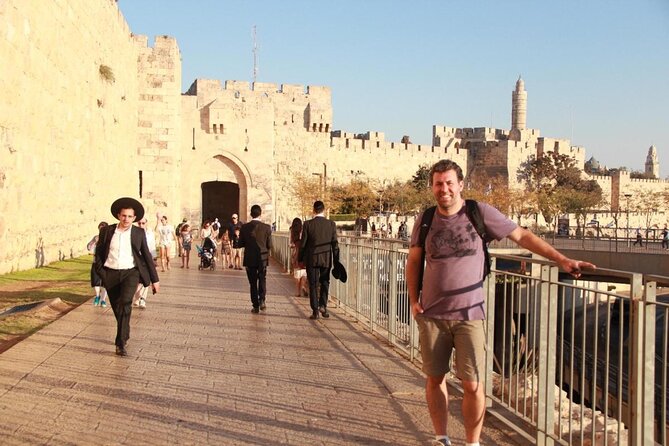
The day begins at 9:00 a.m. at the Tourist Information Center on Omar Ibn Katab Street, near Jaffa Gate. This is a sensible starting point for a first visit because Jaffa Gate is the main entrance used by many people arriving to see the Old City.
You begin with a short introduction to the walled city before entering the Armenian Quarter. The stop is only about 10 minutes, but it gives you an important piece of context: the Armenian presence in Jerusalem reaches back to the fourth century, when Armenia adopted Christianity and Armenian monks settled here.
The Armenian Quarter is the smallest of the Old City’s four quarters. A guide adds value here because the narrow streets and religious institutions can seem quiet and closed off if you simply walk through without explanation.
Next comes the Cardo, the main north-south street of ancient Jerusalem during Byzantine rule. The surviving columns and street plan help you picture the Old City as a Roman and Byzantine center, rather than only as a collection of later religious buildings.
More Souk & Old Town Tours in Jerusalem
- Jerusalem: Guided Walking Tour of the Old City
★ 4.7 · 386 reviews - Best seller! Jerusalem old city four quarters tour
★ 5.0 · 123 reviews - Private Tour Jerusalem Old City
★ 5.0 · 118 reviews
The Jewish Quarter, from the Broad Wall to Hurva Synagogue
The Broad Wall is one of the tour’s useful lesser-known stops. Dating to the reign of King Hezekiah, it shows the practical side of Jerusalem’s past: defense, city limits, and the constant need to protect a settlement built on contested ground.
You then spend about 20 minutes at Hurva Synagogue. This is one of the strongest parts of the day. The interior is impressive, but the details make the visit memorable. You see the synagogue’s enormous Holy Ark, described as the tallest in the world, and hear the story of the building itself.
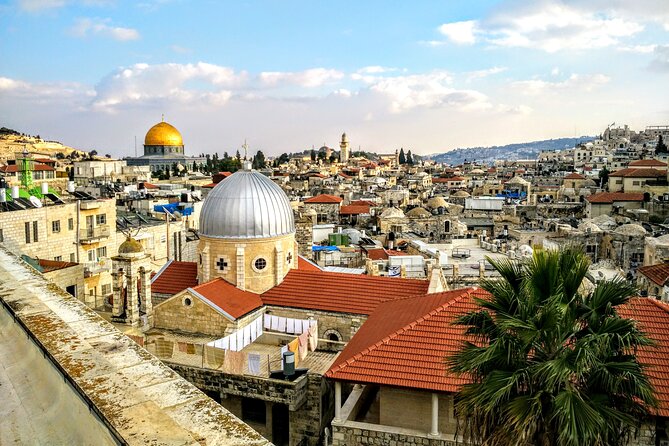
The rooftop offers a 360-degree view of Jerusalem. That view matters because it gives you a physical sense of how tightly packed the Old City is. After spending time in lanes and courtyards, looking out across the roofs helps you understand the relationship between the quarters, walls, and major religious sites.
Admission to Hurva Synagogue is included. You should still dress with the rest of the day in mind, since religious buildings may enforce modest clothing rules.
The Western Wall and the limits of a busy morning
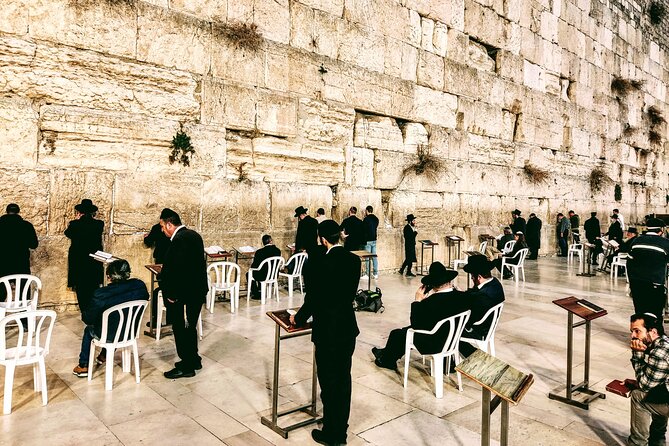
The Western Wall is a 20-minute stop. It is the remaining section of the retaining wall around the Temple Mount, the site associated with the First and Second Temples and one of Judaism’s most important places of prayer.
The guide can explain the wall’s religious meaning and its place in Jerusalem’s modern public life. You may also have a chance to approach the prayer area, but you should not assume that 20 minutes will allow a long, quiet visit. One account specifically found the time too short to get properly to the wall.
That is not necessarily a flaw in the whole tour, but it is worth knowing before you book. This experience tries to cover a large number of sites in one day. If your main purpose is extended personal prayer at the Western Wall, you may want to return separately.
The clothing rules matter here. Men and women need to cover their knees and shoulders. The tour operator has also been criticized for allowing men in shorts and casual shirts to approach the wall, so I would not leave this to chance. Wear long trousers or a long skirt and a top with covered shoulders from the start.
Temple Mount, the Golden Menorah, and the city’s competing claims
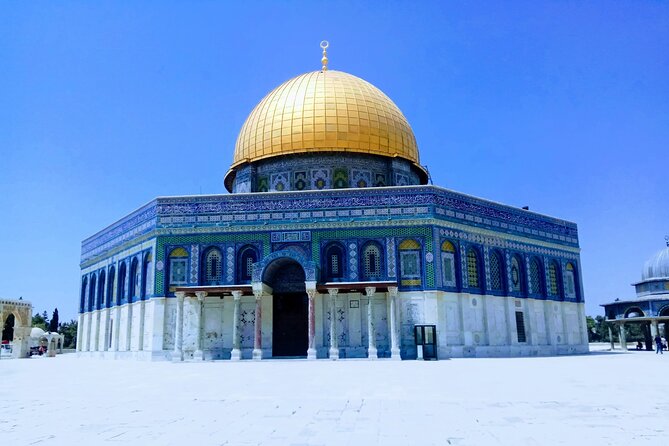
The 35-minute Temple Mount stop shifts the focus to one of Jerusalem’s most sensitive and important places. The site held the two Jewish Holy Temples and now includes the Dome of the Rock and Al-Aqsa Mosque.
The stop is valuable because the guide can connect the physical site with the beliefs attached to it by different communities. You should expect explanation and views of the area as part of the walking route. The supplied details do not promise interior access to the Dome of the Rock or Al-Aqsa Mosque, so do not book this tour expecting a guaranteed visit inside either building.
After the Temple Mount, the Golden Menorah provides another look at modern Jewish religious interpretation. The seven-branched menorah is described in the Bible as a gold lampstand used in the tabernacle and later in the Temple. The version you see is a replacement made by the Temple Institute, based on research by academic and biblical scholars.
This is a short, 15-minute stop, but it adds a present-day dimension to the tour. You are not just looking at old stones. You are also seeing how historical and biblical symbols are represented in Jerusalem today.
More Walking Tours in Israel & Palestine
- Jerusalem Walking Tour: In the Footsteps of Jesus
★ 4.5 · 67 reviews - Boutique Walking Tour of Jerusalem
★ 5.0 · 64 reviews - Walking Tour of Akko (Half-day)
★ 5.0 · 84 reviews - Tel Aviv: Jaffa Half-Day Walking Tour
★ 4.5 · 70 reviews
Following the Via Dolorosa toward the Holy Sepulchre
The tour then follows the Via Dolorosa for about 30 minutes. Today, this is a processional route representing the path Jesus was forced to take by Roman soldiers before his crucifixion.
The value of walking this route with a guide is not simply finding the street. The lanes are easy to confuse, and the religious meaning changes from one section to the next. The guide can keep the sequence clear while also explaining how the route functions for Christian pilgrims.
As with the Western Wall, this part can be busy and compressed. You are covering a working neighborhood as well as a religious route, so the experience is more about understanding the setting than expecting silence or private reflection.
Church of the Holy Sepulchre and Deir Al Sultan
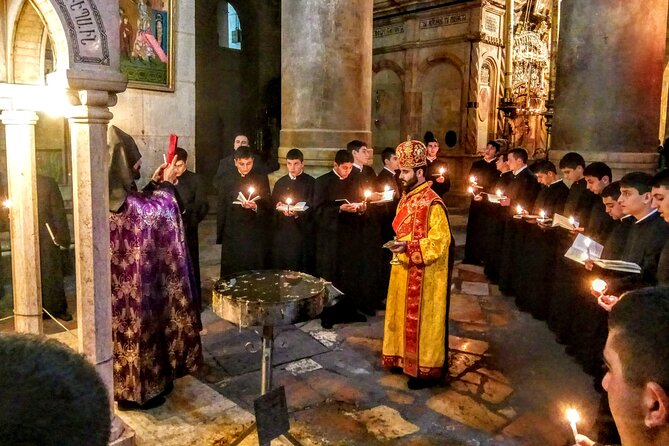
The Church of the Holy Sepulchre receives about 30 minutes. For Christians, it is the most sacred site in the world, associated with the crucifixion, burial, and resurrection of Jesus. Golgotha, the place of crucifixion, is inside the church.
A guide is particularly useful here because the building contains several connected sacred locations and traditions. Without context, it can be difficult to understand why different areas matter or how the church’s spaces fit together.
The final stop is Deir Al Sultan, a monastery on the roof of the Church of the Holy Sepulchre. It is a distinctive ending because many people pass through the church without realizing that this religious community occupies the roof above it.
The site is governed by the Status Quo, an arrangement between religious communities dating to the Ottoman period. The 15-minute visit offers a glimpse of the careful agreements that shape life in and around the church. It also leaves you with a less familiar part of Jerusalem’s religious story rather than ending only at the best-known church interior.
How the six-hour pace feels
The listed stops add up to roughly three and a half hours, leaving time for walking between quarters, explanations, lunch, and the included tea or coffee. That structure is one reason the tour can cover so much without turning every stop into a rushed photo break.
I like the pacing described by the strongest guide feedback. Efrat is praised for patience, clear answers, and prepared historical material. Leontine is praised for strong command of history and culture, well-timed stops, and well-placed food and coffee breaks.
Still, you should be realistic about the format. The Old City involves uneven streets, stairs, crowds, and frequent pauses. Six hours on foot is a serious half-day and more. Most people can participate, but comfortable shoes and sensible clothing will make the day much easier.
The small group helps. Fifteen people is not private touring, yet it is far more manageable than a large coach group once you enter narrow streets or gather beside a major monument. You can usually hear the guide more easily and ask a question without stopping an entire crowd.
What the $120 price includes
At $120 per person, this is not the cheapest way to see Jerusalem’s Old City. The price makes more sense if you value a guide, a planned route, entry to Hurva Synagogue, lunch, and a cafe drink in one package.
Food is a practical advantage. A restaurant lunch gives you a proper break during a long walking day, while the complimentary tea or coffee adds a shorter pause. The exact menu and restaurant are not specified, so you should treat the food as a convenient included meal rather than booking for a particular cuisine.
The tour also saves you the work of building a route through four quarters and several religious sites. You could visit many of these places independently, but you would need to research the Cardo, Broad Wall, Hurva Synagogue, Golden Menorah, and Deir Al Sultan and then fit them around the larger landmarks.
The value is strongest for a first visit. You get orientation, historical links, and practical guidance about religious sites. If you already know Jerusalem well and want a slow, private day focused on one faith or one neighborhood, the fixed six-hour route may feel less flexible.
Practical details that can make or break the day
You receive confirmation when booking, and the experience uses a mobile ticket. The tour starts at 9:00 a.m. and ends back at the meeting point at the Tourist Information Center.
Public transportation is nearby, which makes the start easier to reach. The experience allows service animals, and most people can take part, but the amount of walking remains the key physical consideration.
Dress conservatively from the beginning. Knees and shoulders must be covered for both men and women at places of worship and selected museums. You may be refused entry if you arrive in shorts or a sleeveless top, so carrying a scarf alone may not solve every problem.
The cancellation terms are simple: cancel at least 24 hours before the local start time for a full refund. Changes or cancellations inside that window are not accepted for a refund. The tour also requires a minimum number of people, and if that minimum is not met, you are offered another date or experience, or a full refund.
The overall rating is 4.9 from 83 ratings, with 98 percent recommending it. Those figures point to a strong experience, but the mixed details are useful: guide quality matters, political commentary may not suit everyone, and the Western Wall stop may feel brief.
Who should book this Old City walk
I would choose this tour for a first-time visitor who wants the major sacred sites explained in one organized day. It suits you especially well if you want to compare Jewish, Christian, and Muslim landmarks without planning the route yourself.
It is also a good match if you enjoy history, ask questions, and prefer a small group to a large bus tour. The guides named in the feedback, especially Efrat and Leontine, have the kind of patient, well-prepared approach that makes a dense subject easier to follow.
I would think twice if you want a quiet spiritual visit, extensive time at the Western Wall, or a tour free of political opinions. You should also consider another plan if a six-hour walk, strict clothing requirements, and a set itinerary do not suit you.
Should you book it?
Book this walking tour if you want an efficient first look at Jerusalem’s Old City, with lunch, tea or coffee, a small group, and strong historical guidance included. The Hurva Synagogue rooftop, Deir Al Sultan, and lesser-known walls give it more substance than a route built only around famous landmarks.
Go ahead if $120 fits your budget and you value having the day organized for you. Just dress correctly, wear comfortable shoes, and keep your expectations clear: this is a full sightseeing walk with many stops, not a slow private pilgrimage.
FAQ
Where does the tour begin?
The tour begins at 9:00 a.m. at the Tourist Information Center on Omar Ibn Katab Street in Jerusalem, near Jaffa Gate.
How long does the walking tour last?
The experience lasts approximately six hours.
How large is the tour group?
The group has a maximum of 15 people.
Is lunch included?
Yes. A lunch at a local restaurant is included, along with complimentary tea or coffee at a local cafe.
Which major religious sites are visited?
The route includes the Western Wall, Temple Mount, Via Dolorosa, and Church of the Holy Sepulchre. It also visits Hurva Synagogue, the Golden Menorah, and Deir Al Sultan.
What should I wear?
You must cover your knees and shoulders. This rule applies to both men and women at places of worship and selected museums. Shorts and sleeveless tops may lead to refused entry.
Can I cancel for a refund?
Yes. You can cancel at least 24 hours before the local start time for a full refund. Cancellations and changes made less than 24 hours before the start are not accepted for a refund.
More Walking Tours in Jerusalem
- Amman Walking Tour: Hidden Gems, Culture & Street Food
★ 5.0 · 241 reviews - Middle Eastern Food & Culture Walk in Old Dubai
★ 5.0 · 206 reviews - Muharraq Cultural Walking Tour
★ 5.0 · 170 reviews - Historic Old Dubai & Souk Small Group Walking Tour
★ 5.0 · 156 reviews
Newest Jerusalem trips on the site
- Jerusalem: Half-Day Tour from Tel Aviv★ 3.8 · 54 reviews
- Jerusalem: Tour with Private Guide★ 4.9 · 33 reviews
- From Tel Aviv: Jerusalem Old City Guided Tour★ 4.6 · 59 reviews
- Holy Jerusalem Half-Day Tour From Jerusalem★ 3.8 · 47 reviews
- Jerusalem: Old City Morning Tour★ 3.8 · 25 reviews
- From TLV- Jerusalem Old & New tour INCL. ENTRANCE FEES & P/U★ 4.2 · 65 reviews
- From Tel Aviv: Old Jerusalem Half-Day Tour★ 3.7 · 55 reviews
- Tel Aviv: Best of Jerusalem Day Tour★ 4.2 · 44 reviews
Souks & Old Towns, compared.
Old Town, Creek, Museums, Souks, & Street Food Tour
Read our review →
Old Town, Souks, Street Food, Guided Tour & Abra Ride
Read our review →
Frame Tickets, Creek, Souks & Blue Mosque Guided Tour
Read our review →
Dubai Aladdin Tour: Souks, Creek, Old Dubai and Tastings
Read our review →
Half-Day City Tour with Blue Mosque, Creek, and Souks
Read our review →
Dubai Half-Day City Tour with Visit to Dubai Gold Souk
Read our review →Old Town, Souks, Street Food, Guided Tour & Abra Ride
Read our review →
Old Town, Street Food, Creek, Souks, & Emirati House
Read our review →Browse the lists this tour appears in